The Elicit API and MCP: Powering autonomous research engines


1 min read

We believe that very soon, AI agents will become a core part of how scientific work gets done. Nearly every large pharma company is already deploying agents and co-scientists. But agents can only do reliable science if they have access to reliable evidence.
Elicit was built for this problem before agents even existed. Since 2018 we've worked on an approach called factored cognition: instead of one opaque model doing all the work, evidence synthesis runs as discrete building blocks for search, screening, extraction, and reporting. Because each block is validated on its own, the blocks can be combined in whatever way a task demands while maintaining a high level of rigor.
Today we're making those building blocks available through the Elicit API and MCP server. Elicit’s core capabilities, are now available to power your autonomous research engines in two ways:
The API puts evidence synthesis into your pipeline: Call search, reports, and systematic review programmatically and run them at scale, inside the systems your team builds on.
The MCP server brings Elicit into the tools where you work: Connect Elicit as a Claude connector or ChatGPT plugin through their directories or to other MCP-compatible clients to get Elicit's results without leaving your workflow.
The capabilities
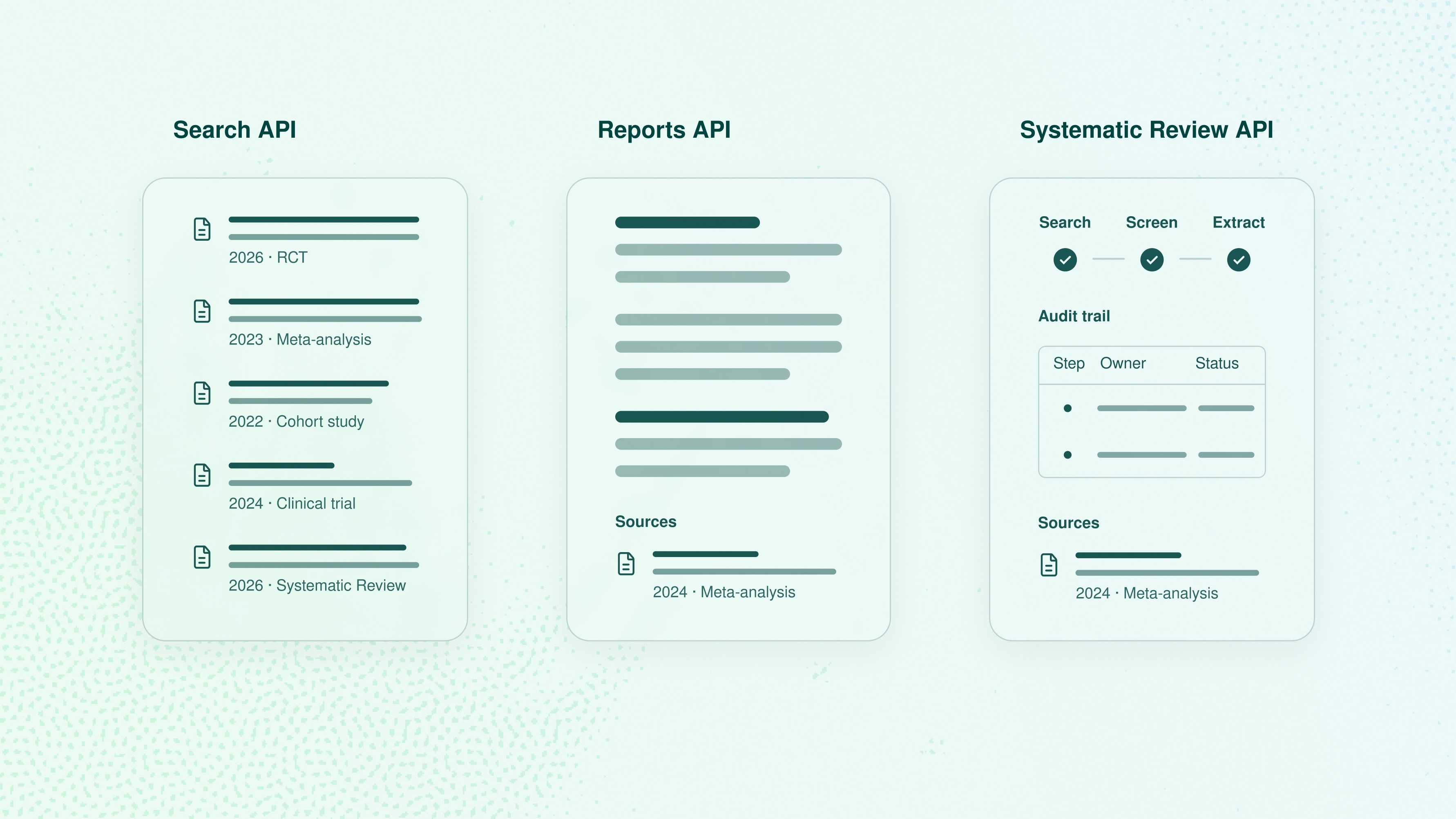
Three endpoints are now available. Each endpoint can be called alone or in combination with the others. These capabilities are also accessible via the MCP server.
Search API: With this API, you can query over 138 million academic papers and ClinicalTrials.gov records using semantic or keyword search. Results can be filtered by year, journal quartile, and study type. Retracted papers are excluded by default. Our API had the best search results (paper recall) when compared against four of the most popular search tools on BioASQ benchmark.
Reports API: With this endpoint, you can submit a research question and Elicit searches for and screens relevant evidence, extracts structured data, and returns a full report as markdown, PDF, or DOCX. You can also run multiple reports in parallel and retrieve the results with the attached evidence when ready.
Systematic review API: This API allows you to run the full systematic review as one flow across search, abstract and full-text screening, extraction, and a final report. Every stage can be exported to CSV or XLSX, with each decision recorded, so the review is auditable end to end.
What customers are building
People are starting to build research workflows around Elicit that go far beyond single searches. They’re connecting it to agents, automation systems, and internal tools to create research pipelines that run continuously. Here are a few examples of what we’re seeing:
A venture fund running an always-on research pipeline: One fund founder has connected Elicit to an automated system where scheduled jobs and coding agents run research tasks, and deliver completed reports as audio briefings. She has instructed her agents to use Elicit because, in her words, much of today’s AI-generated research is still “vibes on the internet.” She wants answers grounded in real studies with citations she can trace back to the source. With API access, her agents can run research directly as part of her automated workflow.
A life-sciences investment firm accelerating due diligence: A research lead built Elicit into an agent that helps her evaluate new assets, reducing roughly 20 hours of upfront research per asset. Work that previously required a multi-person team over two weeks can now be completed much faster.
A healthcare agency building a pharma insights engine: An AI lead at a healthcare communications agency is using the Elicit API as the literature layer for an internal tool that supports pharma pitch preparation. This automation is expected to save 80% prep time. The team had previously built a PubMed integration, but replaced it with Elicit because it provided broader coverage and more useful results. After testing the system, researchers found the results reliable enough to incorporate into their workflow without reviewing every search manually.
A PhD student using an agent to find evidence while writing: An engineering PhD candidate uses a coding agent to query Elicit whenever he highlights a claim in a draft. The agent finds relevant papers and inserts citations directly into his work.
Get started
The API and MCP server are available today on Pro and higher plans. To make the first API call, generate a key at elicit.com/developer. To connect the Elicit MCP, add it as a Claude connector or ChatGPT plugin, or follow these instructions for other MCP clients.


