
The Elicit API is available today in preview for Pro and Teams users. You can search 138M+ papers and generate Research Reports from your own AI tools and scripts.
Why an API
Elicit is good at answering research questions comprehensively and transparently. But you don't always want to open a new tab to ask one. The API lets you get evidence from Elicit wherever you already are whether that's Claude, a Python script, or Slack.
We've been using it internally for a while now and kept finding new ways it's useful. Here's what we've seen so far.
What you can do with it
Run research at scale. Got 30 compounds to check, or 20 hypotheses to test across different populations? Instead of running each one manually in the app, you can loop through them in a script and get structured results for all of them.
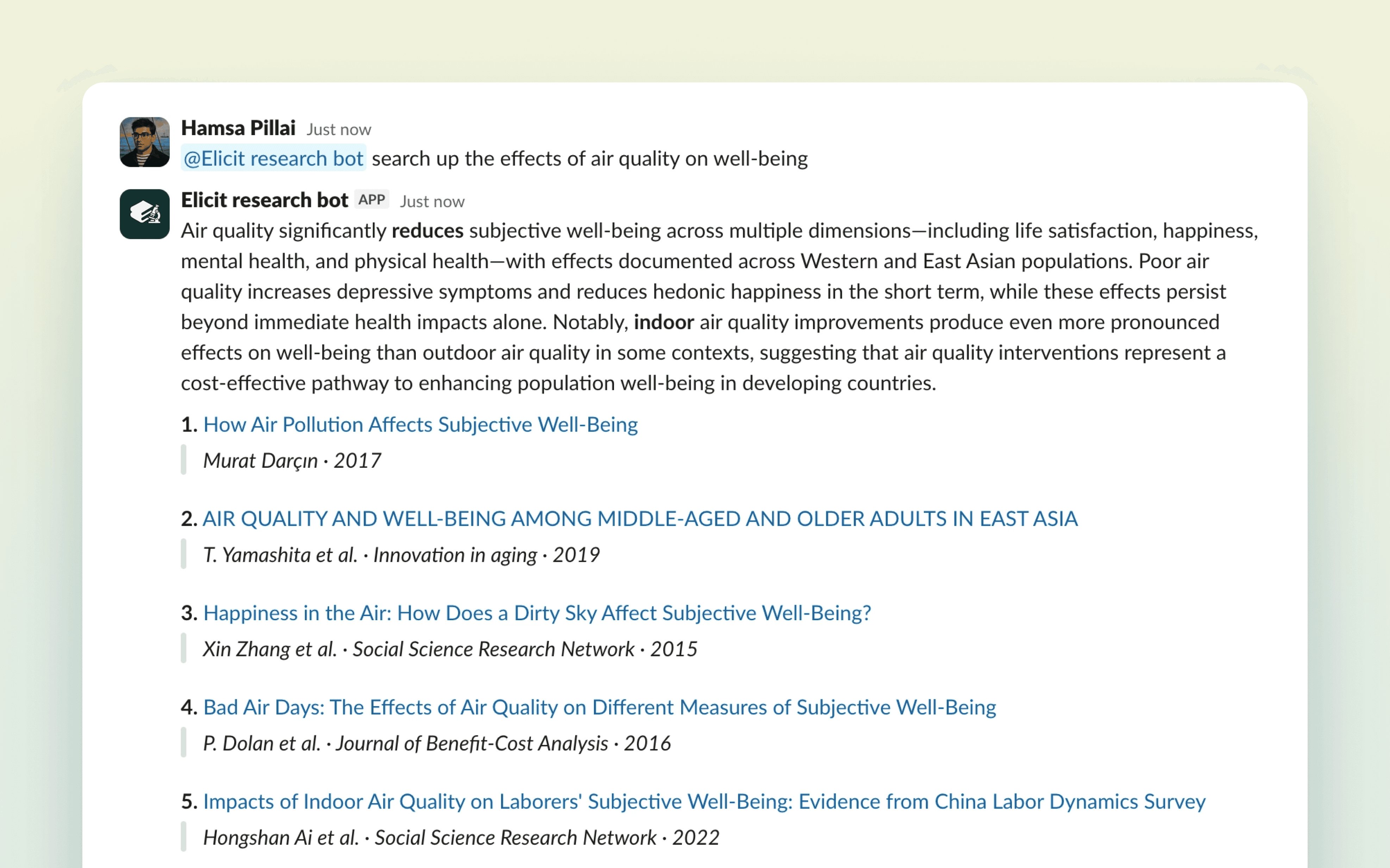
Integrate Elicit into your workflow. Call the API from Claude or ChatGPT to get real citations while writing a paper, or build a Slack bot that pulls evidence into team discussions. We built one internally to make our discussions more evidence-based. Someone asks "what does the evidence say about X?" and the bot returns relevant papers in the thread.
Build on top of Elicit. Many of you have asked about building internal research dashboards or combining Elicit evidence with your own datasets. We wanted to make that possible. You can use Elicit's search and report generation as a layer in whatever you're creating: pipe results into your own database, feed them into a downstream analysis, or surface them in an internal tool your team already uses.
These are the use cases we built the API for but we’re looking forward to seeing what you will build with it.
What the API can do
Search. Send a research question and get back structured JSON results: titles, authors, abstracts, citation counts, DOIs, and PDF links. Elicit's semantic search finds relevant papers even when your exact terms don't appear in the text. You can filter by study type, publication year, journal quartile, and more.
Each result comes back as a JSON object with all the fields you'd see in the app. Search is synchronous so you’ll get back results in the response.
Reports. Submit a research question and Elicit does the full review: search, screen, extract, and synthesize. Reports are async. Kick one off, get back a report ID, and poll until it's done (typically 5–15 minutes).
Getting started
If you use Claude or ChatGPT:
Create an API key at Account Settings → Integrations
Give the AI your research question and the API docs
It'll write a script you can run to get results
If you write code:
Create an API key at Account Settings → Integrations
Copy one of the code snippets above, swap in your key, and run it
Check out more code examples at https://github.com/elicit/api-examples. API reference and information on authentication, billing, and rate limits are available at docs.elicit.com.
This is a preview. We're curious what you'll build with it, and we'd love to hear what you'd want to see before we fully launch.


