
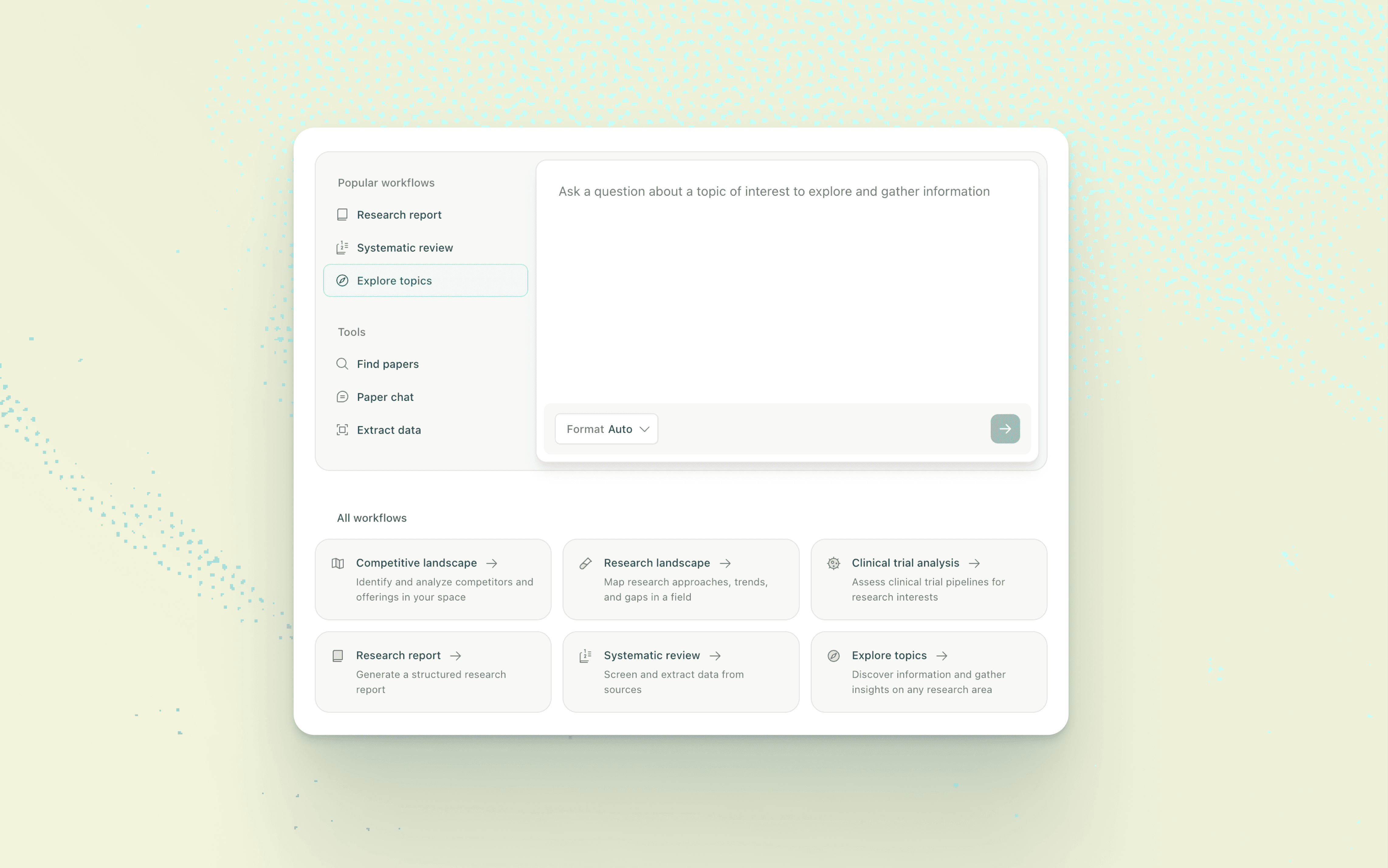
Today, Elicit takes a big leap forward. We’re excited to launch our agentic platform in beta. Our agentic platform is more flexible and powerful than anything on Elicit to date, while still upholding our values around systematicity and transparency.
Systematic reviews are a specific, rigorous process grounded in academic publications. For many research questions, this approach works well. But it isn't sufficient for all research needs. Real-world research often demands more: comparing products across regulatory filings, mapping competitive landscapes from press releases and company announcements, or analyzing clinical trial data from specialized databases. Until now, this meant leaving Elicit and piecing together information from dozens of sources manually.
That's why we're introducing workflows powered by our Research Agent for Pro, Teams, and Enterprise users. These workflows let you tackle more complex research questions that demand flexibility—flexible sources that go beyond publications, flexible outputs that match your needs, and the ability to iterate until you get exactly what you're looking for.
Powering these workflows is the Elicit Research Agent, which we've developed to take a unique approach to complex research questions. Rather than simply searching and summarizing, it breaks down your prompt into a systematic program, then executes that program to produce reliable output where all claims are grounded in evidence.
Why this matters for your work
Our agentic platform unlocks three key capabilities that fundamentally expand what's possible on Elicit.
First, you can now draw from sources well beyond academic publications. The Elicit Research Agent can search the broader web including clinical trial data, regulatory documents, press releases, and product labels - pulling together information that previously required manual searching across many different platforms.
Second, you get flexible outputs that match your actual needs. If you're building a competitive landscape, you might want a structured comparison table. If you're exploring a new research area, a narrative summary might serve you better. You can even produce multiple artifacts at once - say, a detailed table alongside an executive summary.
Third, and perhaps most importantly, you can iterate. Research isn't a one-shot process. After seeing initial results, you often want to dig deeper into one area, broaden your scope, or reshape your output entirely. These workflows let you ask follow-up questions, request new analyses, or refine outputs until you have exactly what you need—all within the same session. This maps to how research actually works rather than forcing you into a rigid, linear process.
The result of this new approach: research that used to take days can now happen in hours, all while maintaining Elicit's systematic approach and comprehensive citations.
What's new
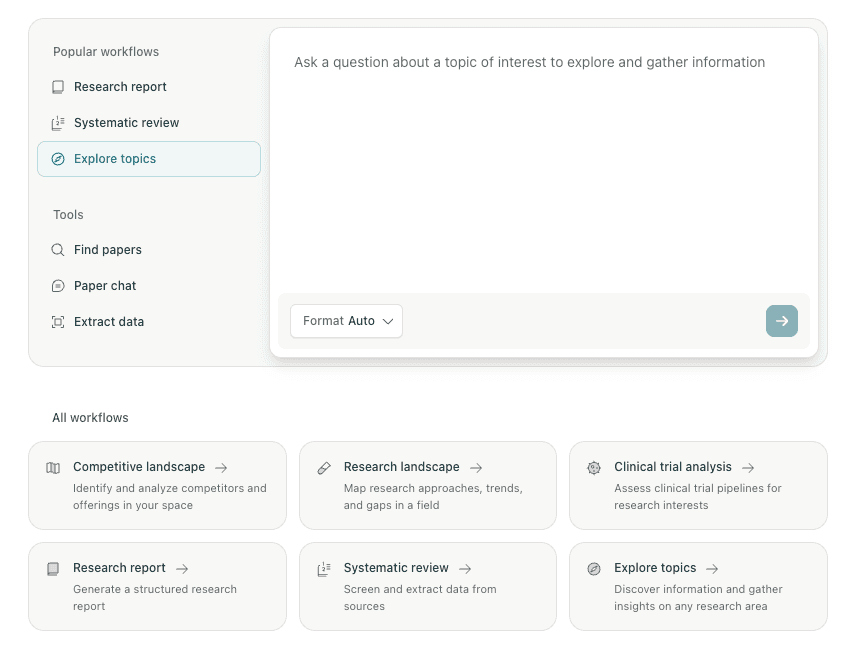
Users with a Pro or above account now have access to four new research workflows from the Elicit homepage, each powered by the Elicit Research Agent:
Competitive landscapes – Map out and compare products, companies, or therapeutic approaches across the sources that matter most for your analysis.
Research landscapes – Understand the full scope of work happening in a field, including who's working on what and where the field is heading.
Clinical trial analyses – Analyze trial designs, endpoints, and outcomes across multiple studies from ClinicalTrials.gov and related sources.
Topic exploration – Investigate any research question without predefined structure, and using chat to dig deeper
How it works
When you visit the Elicit homepage, you'll see the new workflows available alongside your existing options. Click on one—say, "Competitive landscape"—and you'll be asked to choose your desired output format and provide a prompt describing what you're looking for.
Here's where the agent approach differs from traditional tools. Instead of immediately running a search, the Elicit Research Agent first asks clarifying questions to make sure it understands your needs. It might ask about which sources to prioritize, how you'd like the output structured, or what the boundaries of your question should be. This upfront conversation helps ensure the agent's work actually addresses what you care about.

Once you've answered these questions, the agent gets to work. Through an extended thinking process, it searches across relevant sources, evaluates what it finds, and synthesizes the information into your requested output. You can watch this process unfold, seeing which sources the agent consults and how it's building toward your deliverable.

When the initial output is ready, the real power of the agentic approach becomes clear. You're not stuck with what you got. You can chat with the agent to ask questions about the results, request modifications to the existing output, or spin up entirely new analyses based on what you've learned. The session becomes a workspace for iterative research rather than a single query-response interaction.

This is a beta launch
We're releasing these workflows in beta because we want to learn from how you use them. Your feedback will directly shape how these capabilities evolve.
Agent-powered workflows are available to Pro, Teams, and Enterprise users today. Try them from your Elicit homepage.
What's next
This is just the beginning of agent-powered research on Elicit. We're continuing to expand the types of workflows available, the sources the agent can access, and the ways you can interact with and refine your results. We're excited to see how these new capabilities accelerate your work.


